
Windham County VINELink Coverage
Connecticut calls its VINE service CT SAVIN, the Connecticut Statewide Automated Victim Information and Notification system. The official access point is the Connecticut VINELink page, and the toll-free line is 1-866-277-7477. CT DOC Victim Services says the network carries events from both the court and correctional systems. In Windham County, that distinction matters. Connecticut placed its former county jails and state prisons under CT DOC in 1968, so there is no Windham County sheriff jail feed to supply a separate VINE roster. Brooklyn Correctional Institution reports through the state correctional structure.
Accused-status notices may cover bond out from a correctional facility, discharge from court, escape, and return to custody. Post-conviction notices can include a parole hearing, community release review, community placement, end of sentence, escape or absconding, and inmate death. An absconding event means a person under community supervision stopped required contact. These event types are broader than a simple released or held label. They can help a registered user follow a specific case as authority shifts between a Windham County court, CT DOC, and parole staff.
Coverage also depends on the custody system. A sentenced federal prisoner belongs in the Federal Bureau of Prisons locator, not CT SAVIN. A person held by ICE must be checked through the ICE detainee locator. A local police arrest that never entered CT DOC may be documented by the police agency and court instead. Choosing the system first prevents a blank VINE result from being mistaken for a confirmed discharge.
Search Windham County VINELink Records
Start with enough facts to separate people who share a name. A CT DOC number or other agency ID is strongest. Name and date of birth can narrow a broad result set. Open the individual result and read the reporting agency, custody state, and last event together. A match tied to CT DOC is different from a court-case match. If the person was processed only through a courthouse lockup, the judicial side may have the useful event even when the correctional side has none.
- Open Connecticut in VINELink and choose the offender or custody search.
- Enter the person's name or identifying number. Add more identifiers when the result list is broad.
- Open the matching record and confirm that the birth details, ID, and reporting agency fit.
- Read the custody status and event date without treating a transfer as a release.
- Compare a disputed result with CT DOC or the Connecticut Judicial Branch docket.
A no-result response has several possible meanings. The person may have fully discharged, the source feed may lag, the matter may be youthful-offender or erased, or the custody may be federal or immigration-related. It does not prove that no custody event occurred. The broader Windham County released inmate search on the home page explains which official system controls each kind of release.
For Windham County court matters, note the location as well as the name. Geographical Area No. 11 in Danielson handles court processing that can lead to bond or discharge, while the Windham Judicial District court in Putnam supplies records for more serious matters. Neither court runs a public detention roster. Its docket is useful because it records the legal act that changed custody, even if no county release list ever existed.
Windham VINELink Release Fields
VINELink wording can vary with the agency feed and the live record. Read fields as a current report, not as a certified release document. A released result may state that the person is no longer in custody or no longer held at the reporting facility. When the record remains active, the following details help identify what the status actually means.
| Field | What it can show |
|---|---|
| Name or offender ID | Helps distinguish the intended person from another person with a similar name. |
| Custody status | Reports the state supplied by the correctional or court source. |
| Reporting agency | Shows whether the event comes from CT DOC or a connected judicial source. |
| Facility or location | May name the reporting institution or unit, but a transfer can change it. |
| Event | May identify bond out, court discharge, community placement, end of sentence, or another change. |
| Notification option | Allows registration when the live record supports alerts. |
VINELink does not replace the underlying record. For a CT DOC sentence, the official offender detail may also show Estimated Release Date, Special Parole End Date, date of sentence, location, status, or a detainer. A detainer is a hold from another authority that can prevent a person from leaving custody when one case ends. Court records, by contrast, can explain bond, dismissal, nolle, sentence, probation, or a court discharge.
The event date needs the same care. It may mark when the source posted an event rather than establish every part of the release process. A correctional end-of-sentence notice, a court discharge, and a parole community-placement notice describe different legal paths. Save the agency name and exact event text before calling an office, since those details help staff find the right record.
Register Windham County Release Alerts
Registration begins from the matched person's record. Select the notification option, then choose a method available on the live Connecticut screen. CT SAVIN materials list phone, email, and TTY. Text or app notifications may also be available through the current platform. Use contact details that can be checked reliably, and save the confirmation. For phone alerts, VINELink may require a personal identification number, or PIN, to confirm receipt and manage notices.
- Choose “Get Notified” or the current notification button on the matching record.
- Select each available method that suits the need, such as phone, email, TTY, text, or an app notice.
- Enter the requested contact information and review it for errors.
- Create the phone PIN or confirmation code when the screen requests one.
- Finish registration and retain the confirmation details.
An alert should prompt verification, especially when timing is urgent or a status is unclear. CT DOC says its public information is updated daily but can change fast. A parole vote is also not the same as a door-out time. The Board of Pardons and Paroles calls its date an “on or after” date because release conditions, transportation, and review still must be complete.
Windham Release Alerts Need Two Tabs
Connecticut adds a local step that is easy to miss. The CT DOC Victim Services Unit says VINELink registration has an OFFENDERS tab for CT DOC information and an OFFENDERS WITH COURT CASES tab for judicial information. A person who wants both kinds of Windham County notice may need to register under both. One sign-up should not be assumed to cover the full path.
This two-tab rule follows the way a release occurs. A bond out or discharge from court begins with judicial authority. A state prison end-of-sentence event comes from CT DOC. Parole review can involve the Board and CT DOC Parole and Community Services. Registering on the correctional side alone may miss court events, while the court side alone may not provide later correctional placement or sentence-end notices. Check the matched identity in each tab and save both confirmations when both streams are needed.
Read Windham VINELink Results
The Connecticut VINE application route shows the state entry point used for person searches and alert options.
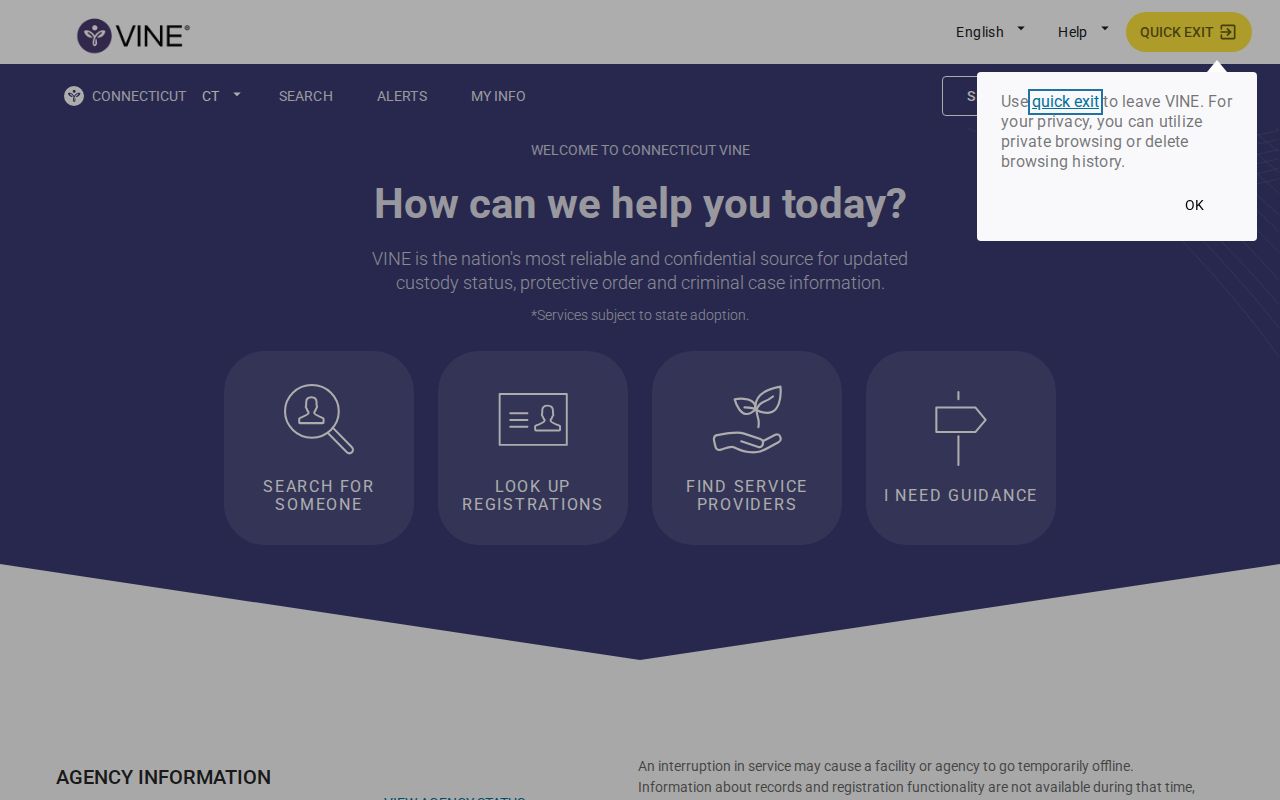
The screen is a route into the live service, so button names and available fields should be read as they appear at the time of the search. Keep the matched agency in view. A CT DOC result and a judicial result can refer to related events without reporting the same legal fact.
Verify Windham County VINELink Releases
Use the agency that created the event as the final check. For Brooklyn Correctional Institution or another state facility, search the CT DOC Inmate Information system. Search by DOC number when known, or use name and date of birth. Open the detail and review status, location or supervision unit, Estimated Release Date, Special Parole End Date, sentence date, and detainer notation when those fields appear. A person on parole or special parole may remain visible because CT DOC still supervises the person in the community.
For a Danielson or Putnam court event, use the Judicial Branch criminal lookup to find the daily docket, pending case, conviction, or docket-number record. The docket can explain a bond release, discharge, dismissal, probation order, sentence, or transfer into CT DOC. When the online record is stale or empty, CT DOC Public Information can be reached at (860) 692-7780, Monday through Friday from 8:00 a.m. to 4:30 p.m. A narrow request should include the person's name, birth date if known, DOC number if known, and the release event being checked.
Windham VINELink Release Limits
VINELink is strongest for current and near-future custody changes. CT DOC warns that once a person discharges and completes the Connecticut sentence, future notifications may stop. If the person later re-enters the justice system, a user may need to register again. A missing old record is therefore not a history of no custody. Court retention rules, erasure, correction, pardon, and a full discharge can also alter what is available online.
Federal prison is outside CT SAVIN coverage. The Federal Bureau of Prisons locator is the correct system for a federal sentence. Immigration detention has its own ICE locator, and CT DOC states that people held for ICE are not included in its inmate database. A transfer must not be read as freedom from every form of custody. When systems conflict, confirm with the reporting court, CT DOC Public Information, BOP, or ICE rather than relying on one automated alert.
For a written confirmation, ask for a narrow release or discharge record. Include the person's name, birth date if known, DOC number if known, releasing facility, and the date range. Request the public release date, release type or authority, and transfer or detainer notation if one exists. This produces a focused agency response and separates the custody fact from the broader criminal case file.